Thursday, May 2, 2013

Reflection

Reflect on your knowledge of design history before the class and after the class.  Describe two areas of design that were particularly interesting to you and why.

I feel that I can into this class knowing alot about the eras we researched because I’ve always had a fascination with history and art history in particular. Though this class I’ve learn to study furnishings and interiors deeper than for the way it looks. I’ve also learned how to classify things by common characteristics of a particular time period. The two areas of design I like best are the Greek and Roman times. I can’t really explain why, I think it started with my fascination with mythology. The Greek and Roman eras are so rich with thought, change and life in general. I particularly love that everyone was an artist, sculptor, philosopher, writer, such an artistic time. The art of the time is something i could look at for hours, days, or even years. It’s something about the way it speaks to me, everything seems so strong and decisive. There’s some kind of unexplainable bond I feel about the way things look, move, feel, and are made. Sort of like the saying, “they don't make them like that anymore”. To me its just a beautiful time in our world’s history. 


Saturday, April 20, 2013

Reaction Styles

The 5 reaction styles already covered (Aesthetic, Macintosh, Art Nouveau, Arts and Crafts and Vienna Secession) were reactions to their current age.  Identify what each reaction was and discuss how their reaction was interpreted in design (this can include talking about a few general features or by referencing a specific piece).

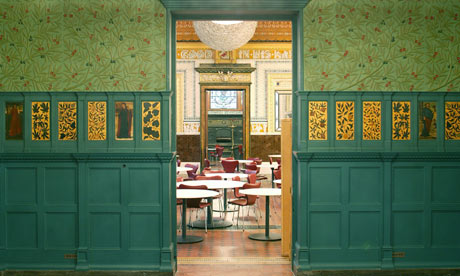
The Aesthetic Movement was a reaction to and the rejections of strict art and attitudes of the Victorian period. The movement communicated that art should not convey any moral, sentimental, or educational message; that it should only be beautiful art.  The Aesthetic style is heavily influenced by Oriental style, as you can see with the black lacquer, gold gilding and pagoda like build of this over-mantle piece. You see this again with the oriental screen inspired panel paintings and the jade color of the Green Dining Room at the Victoria & Albert Museum.

Aesthetic- 

Overmantle Piece


The Green Dining Room at the Victoria & Albert Museum


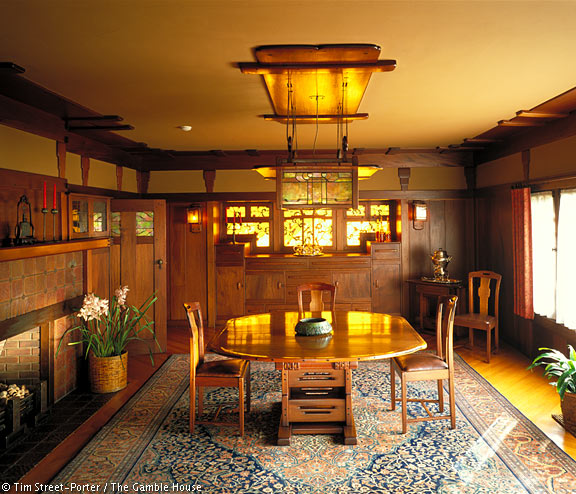
The Arts and Crafts Movement was the reaction to industrialization and mass production. Arts and Crafts purpose was to combine art and craftsmanship and to move away from the busy Victorian style toward a purer simpler style. This movement is also heavily moralized and philosophical. The move to a simpler style gives the movement its stylistic manner, linear shapes and its emphasis on nature. It revived craftsmanship, implying that beautiful things made by hand could enhance the lives of people. The most perfect example of the Arts and Crafts style id the Gamble House by Charles and Henry Greene. This house shows the linear shapes, hand crafted details, and emphasis on nature with it beautiful woodwork.


Arts & crafts-

Gamble House


Gamble House Front Doors


Gamble House Ornate Brackets


Gamble House Dining Room


Art Nouveau is a reaction against the historical and cluttered styles. It was also meant to be and aid to escape from the evils of modern society. Key point in this movement was the return to nature, the designing of whole spaces instead of on piece, and ideal that the design should have movement. With Art Noueavu a lot of the design seems to look alive and ready to move; much like Bernhard Pankok's Viytrine piece. This cupboard looks like it could stand up and walk away at any moment. You can also see the movement and escapism or fantasy in the dining room by Eugene Valin Masion Masson. For me if you blink too much or too fast it seems as though the room took a breath. Also the curves and sweeping motion of the wood make it seem very organic. You can tell the room was specifically designed because the room looks like it came as a set every part of the room and furniture echoes each other

Art Nouveau-


Bernhard Pankok: Viytrine, 1899


Dining Room by Eugene Valin Maison Masson
http://contemporarypractice.files.wordpress.com/2009/12/scan0001a1.jpg?w=497&h=673

The Mackintosh style was created by Charles Mackintosh and his wife Margret McDonald in reaction to and a combination of Art Nouveau, Arts and Crafts, and Aesthetic movements. Mackintosh used the influence of local traditions and materials, along with his own ideas of beauty and design to create his designs. Some key notions for him are a play between light and dark, a play on femininity and masculinity, and that beauty should generate from the inside out. The Hill House exemplary of these features. The outside of the building isn't much to look at but the inside is remarkable. In the photo of the living room you can see the play on light and dark with the dark ceiling and flooring and large windows and light walls. The large windows letting in natural light allows the room to different depending upon sunlight of the day. The Art Nouveau and femininity/ masculinity play can be seen in the lines and curves of the bookshelf from the Hill House.

Macintosh-

Hill House

Hill House Living Room


Hill House Bookshelf

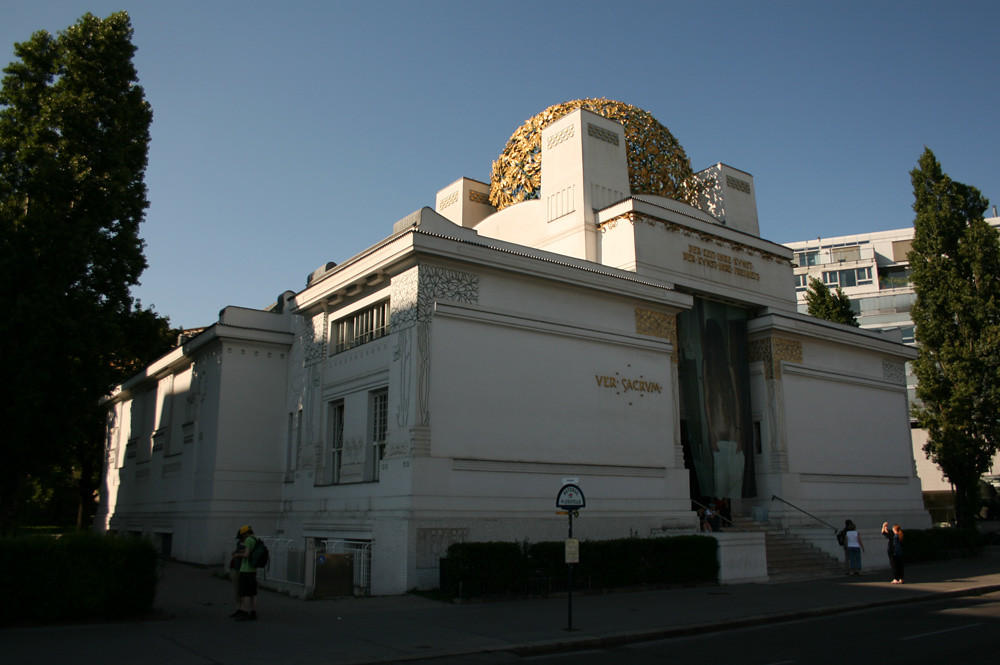
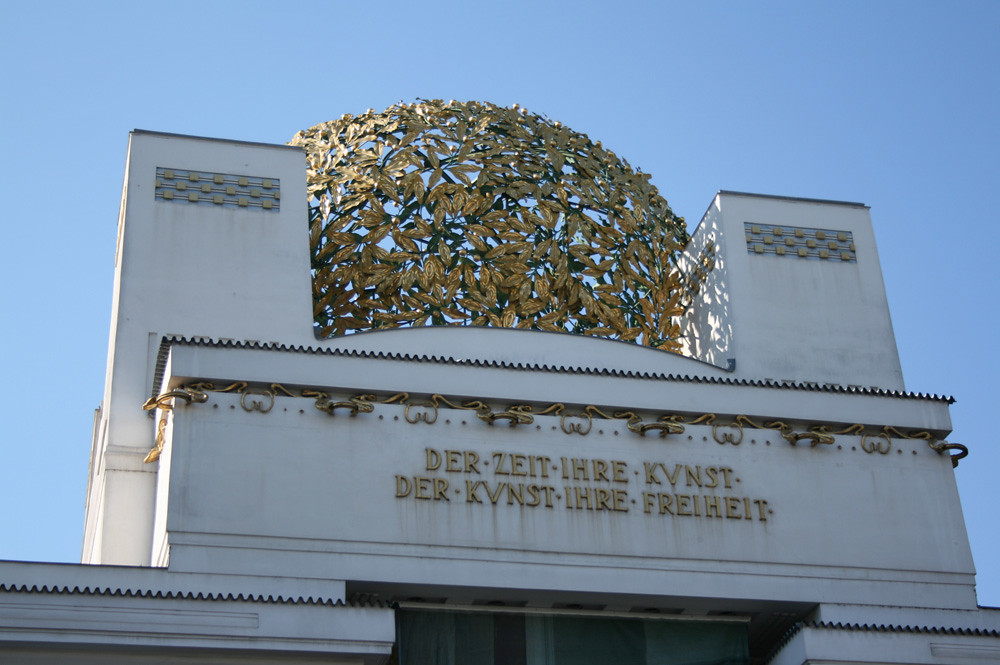
The Vienna Secession is another movement resulting from a rebellion or separation from the traditional and historical styles of art. The point was to create a completely new style unlike anything anyone had seen or done before with no ties to historical art. In this style geometric forms, linear lines and an abstract look was preferred. 

Vienna secession-


The Kiss, Gustav Klimt 1907-1908


The Secession Exhibition Hall


http://farm5.static.flickr.com/4104/4986634590_e647021c4c_b.jpg

Saturday, March 2, 2013

Blog Question 7 Baroque and Rococo

1.    List and describe three distinct features of Baroque art and/or design?

     A distinctive element of Baroque art is chiaroscuro and tenebrism. Chiaroscuro is the treatment of light and shade in drawing and painting. This is an effect of contrasted light and shadow created by light falling unevenly or from a particular direction on something. Tenebrism is from the Italian tenebroso (murky), it is also called dramatic illumination. This combination makes a picture looks like there is a spotlight on or in it. The Baroque artist Caravaggio, is usually credited with the invention of the style.  Yet there were many artist who display this light dark play beautifully, such as Tintoretto’s The Last Supper; Velázquez’s Las Meninas and Peter Paul Rubens’ A Night Scene.

     Another component of Baroque art is energy and movement. This is most visibly apparent in sculpture of the time. This sense of motion is called dynamism.  A lot of the sculptures display in their uncontrolled poses with twisting torsos, unbalanced postures, and strong curves. Baroque statues regularly have multiple ideal viewing angles, and are designed to be placed in the middle of a large space to see all angles. You can see these features in Bernini’s The Ecstasy of Theresa, Augustin Pajou, Psyché abandonnée (Psyche Abandoned), Angelo de' Rossi, St. James the Less.

     One more classic feature of the Baroque era is the external façade. The external façade often characterized by a dramatic central projection. The difference between a Renaissance façade and a Baroque façade has to do with the ornamentation of the structure.  A Baroque façades, regularly exhibits a focus of rich elements like blind arches, curved walls, statues, relief sculpture, and columns around a central entrance, which strongly draws the eye. Whereas Renaissance façades usually consist of identical sections, which one’s eye isn’t really drawn to any particular point.

2.    List and describe three distinct features of Rococo art and/or design?

     A significant feature of Rococo art is the use of pastel colors. The light colors were used to oppose the dark, bold colors used in Baroque art. At this time the use of delicate, bright color important to reflect the mindset of the people in the era. Pastels were used in paintings and also in interior design. You can find this in Francois Hubert Drouais’ Marquise de Caumont La Force, Franz Xaver Winterhalter’s Princess Elizabeth Esperovna Belosselsky and in the interior of “Green Room” of Charlottenburg (Berlin).

     An additional component of Rococo art light subject matter. In this particular time period people wanted to stray from the seriousness and religious matter shown in Baroque art. The Rococo style of art is all about leisure, love, lightheartedness, pleasure and a little erotica. You will find pieces of art with people playing, and lounging and even a little nudity. People in this era wanted to kick back relax and have carefree fun. Also even though there was nudity in these paintings it was done in a vulgar way but a more tasteful refined approach. These features are shown throughout art pieces such as Jean-Antoine Watteau’s The Scale of Love, François Boucher’s, Resting Girl (Marie-Louise O'Murphy), and Jean Honore Fragonard’s The Musical Contest.

     A lasting feature of the Rococo era is the ornamentation. In Rococo the decoration of decoration was very popular. Walls were covered in murals, plaster, paneling and then adorned with sculptures and more paintings. This was mimicked inside and out, the outside of buildings were festooned as heavily as the inside. It was very important to over decorate a space in more than one feature. Everything from everyday houses to churches demonstrated this ornate elaboration. To see this we can look at the Salon de la princesse Hotel de Soubise, Paris and the Sanssouci Palace; Potsdam, Germany.

3.    Describe some of the evolutions in furniture that come out of these eras.

     Furniture before the times of the Baroque and Rococo eras was hard, heavy, architectural, and functional only. Furniture was only used as necessity not because people liked it or because it was comfortable. During the time before these eras furniture was anything but comfortable. Also there was no plan of how furniture should look therefore it looked like the only thing people really knew which was architecture. This ideal of furniture resembling architecture still applied to these times but it also developed into its own entity and form. Like I mentioned before ornamentation is a big thing at this time and you see it all over the furniture.

     At these times furniture began to get comfortable, chairs started having backs and arms to them, they were even elongated into the couch, and everything had padding. This was because it became acceptable to lounge and relax. Another aspect to come out of this time is the need to decorate the whole piece of furniture. Before furniture was decorated by laying a tapestry over it but now furniture was decorated the same way the walls and exteriors of buildings. Another reason furniture was decorated all the way around is because now out in a room rather than pushed against a wall this again goes back to it being acceptable to relax in public settings. Furniture moving into the middle of a room also called for it to be light weight. Before now furniture was heavy and unmovable because you didn’t want anyone to steal it but I presume this became less of a factor because furniture became easy to be moved it around for necessitates of a social settings. This can only be achieves if furniture light enough for moving.


I tried to add images but for some reason it wouldn't allow me to today and the font isn't cooperating. 

Saturday, February 23, 2013

Renaissance Blog Questions


1.    Describe key players and building of Italian Renaissance and why they are representative of Renaissance design.
 
Francesco Petrarch, who is sometimes called the father of Humanism, created the conceptual framework that set the Renaissance into motion. His Humanist theory stated that God has given man "intellect and creative potential to be used to the fullest". This form of thinking inspired a whole philosophy which many artists, philosophers, politicians, architects and other thinkers of the time embraced. These Humanists were highly motivated and inspired to design a completely new way in which their imaginations could be accessed and expressed without hindrance from tradition and formalism. Thus, Petrarch is equally considered the father of the Renaissance as well.
 
One of the major players of the Renaissance as it relates to design is Filipo Brunelleschi. Aside from his great works of art, he introduced innovative concepts such as graphical perspective. This idea influenced artists, mathematicians and architects to design and paint works that allow a viewer to feel like they are seeing different points of view rather than their actual point of view. As an inventor and mathematician he was able to build large structures by inventing new devices for masonry.
 
Another key player in building the Renaissance was Leon Barrista Alberti. Alberti wrote De Re Aedificatoria in 1485, which was a highly influential work in architectural design circles concerning a theoretical approach. This work helped move the Renaissance along in to the the next phase that focused on classical systems and aesthetics in architecture. Alberti paved the way for Donato Bramante, who developed Renaissance design even further.
 
Michelangelo Bunornarroti introduced more personal expressions in his art and design. This style was known as Mannerism. By using Mannerism, Michelangelo was able to create some of the world's most well-known works of art including the painting in the Sistine Chapel and the sculpture of David. It was his emotive form of expression that allowed and still allows people to perceive his attempts at displaying energy in his art and design. Michelangelo perpetuated the progression of design during the Renaissance by promoting Mannerism.
 
Another person that played a very important role during the Renaissance was Leornardo Da Vinci. Da Vinci, like Michelangelo, was the epitome of the Renaissance Humanist thinker. He created progressive artworks such as The Mona Lisa and The Last Supper. His contributions to design mostly stem from engineering and mathematical concepts. He furthered the Age of Enlightenment by expanded on many concepts that were introduced before he began to play a role.
 
2.    Describe the architectural style of a non-western culture through also identifying several features and whether they have affected western design.
 
There are various architecture styles used within the architectural design of Eastern culture (China) such as imperial architecture, religious architecture, garden architecture and general architecture. The different styles use different structural materials which include brick work, timber construction and bamboo construction.  
 
There were architectural features that reserves solely for imperial architecture. . One example is the use of yellow roof tiles; yellow having been the Imperial color, yellow roof tiles still adorn most of the buildings within the Forbidden City. While the Temple of Heaven uses blue roof tiles to symbolize the sky. The roofs are generally always supported by brackets, a feature common only with the largest of religious buildings. The wooden columns of the buildings, along with the surface of the walls, are usually red. Black is also a famous color often used in pagodas; because they believed the gods are inspired by the black color to descend on to the earth. The Chinese dragon, a symbol reserved for Imperial architecture and are places on roofs, on beams, pillars, and doors. Also included in the Imperial style would be the religious architectural buildings. This meant they shared the same main features like the yellow tile roofs and bracket supports.

Another style of Chinese architecture would be the Garden architecture. Garden architecture started with the practice of developing forests and woods of hunting. The construction of man-made woods then evolved into what would include man-made hills, pools and fountains; which turned into something beautiful. The man-made beauty was eventually able to successfully blend in well with the beauty of the natural environment as the landscapers became more skilled. Soon after gardens became more formal for activities such as holding court, banquets, producing theatrical activities, and to provide a place of worship.

The last style of architecture is Traditional architecture, which is more about residential homes. The most noteworthy feature is the use of timber framework. Wooden posts, beams, lintels and joists typically make up the framework of a house. Without bearing the weight of the whole house walls, assisted only as a separation of rooms. Like most architecture paintings and carvings added to the architectural work made it more stunning and eye-catching.