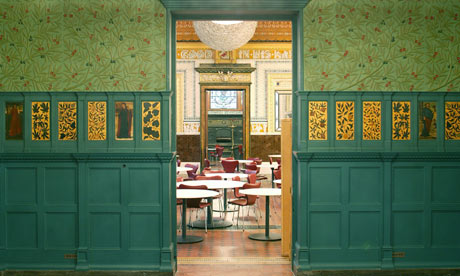
The Aesthetic Movement was a reaction to and the rejections of strict art and attitudes of the Victorian period. The movement communicated that art should not convey any moral, sentimental, or educational message; that it should only be beautiful art. The Aesthetic style is heavily influenced by Oriental style, as you can see with the black lacquer, gold gilding and pagoda like build of this over-mantle piece. You see this again with the oriental screen inspired panel paintings and the jade color of the Green Dining Room at the Victoria & Albert Museum.
Aesthetic-
Overmantle Piece

The Green Dining Room at the Victoria & Albert Museum
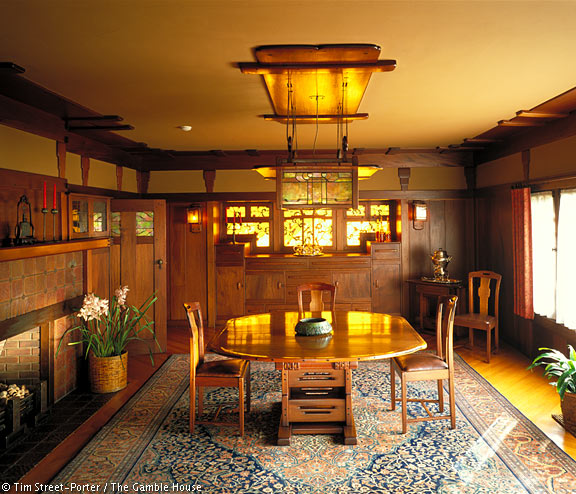
The Arts and Crafts Movement was the reaction to industrialization and mass production. Arts and Crafts purpose was to combine art and craftsmanship and to move away from the busy Victorian style toward a purer simpler style. This movement is also heavily moralized and philosophical. The move to a simpler style gives the movement its stylistic manner, linear shapes and its emphasis on nature. It revived craftsmanship, implying that beautiful things made by hand could enhance the lives of people. The most perfect example of the Arts and Crafts style id the Gamble House by Charles and Henry Greene. This house shows the linear shapes, hand crafted details, and emphasis on nature with it beautiful woodwork.
Arts & crafts-
Gamble House
Gamble House Front Doors
Gamble House Ornate Brackets
Gamble House Dining Room
Art Nouveau is a reaction against the historical and cluttered styles. It was also meant to be and aid to escape from the evils of modern society. Key point in this movement was the return to nature, the designing of whole spaces instead of on piece, and ideal that the design should have movement. With Art Noueavu a lot of the design seems to look alive and ready to move; much like Bernhard Pankok's Viytrine piece. This cupboard looks like it could stand up and walk away at any moment. You can also see the movement and escapism or fantasy in the dining room by Eugene Valin Masion Masson. For me if you blink too much or too fast it seems as though the room took a breath. Also the curves and sweeping motion of the wood make it seem very organic. You can tell the room was specifically designed because the room looks like it came as a set every part of the room and furniture echoes each other
Art Nouveau-
Bernhard Pankok: Viytrine, 1899

Dining Room by Eugene Valin Maison Masson
http://contemporarypractice.files.wordpress.com/2009/12/scan0001a1.jpg?w=497&h=673 The Mackintosh style was created by Charles Mackintosh and his wife Margret McDonald in reaction to and a combination of Art Nouveau, Arts and Crafts, and Aesthetic movements. Mackintosh used the influence of local traditions and materials, along with his own ideas of beauty and design to create his designs. Some key notions for him are a play between light and dark, a play on femininity and masculinity, and that beauty should generate from the inside out. The Hill House exemplary of these features. The outside of the building isn't much to look at but the inside is remarkable. In the photo of the living room you can see the play on light and dark with the dark ceiling and flooring and large windows and light walls. The large windows letting in natural light allows the room to different depending upon sunlight of the day. The Art Nouveau and femininity/ masculinity play can be seen in the lines and curves of the bookshelf from the Hill House.
Macintosh-
Hill House
Hill House Living Room
Hill House Bookshelf

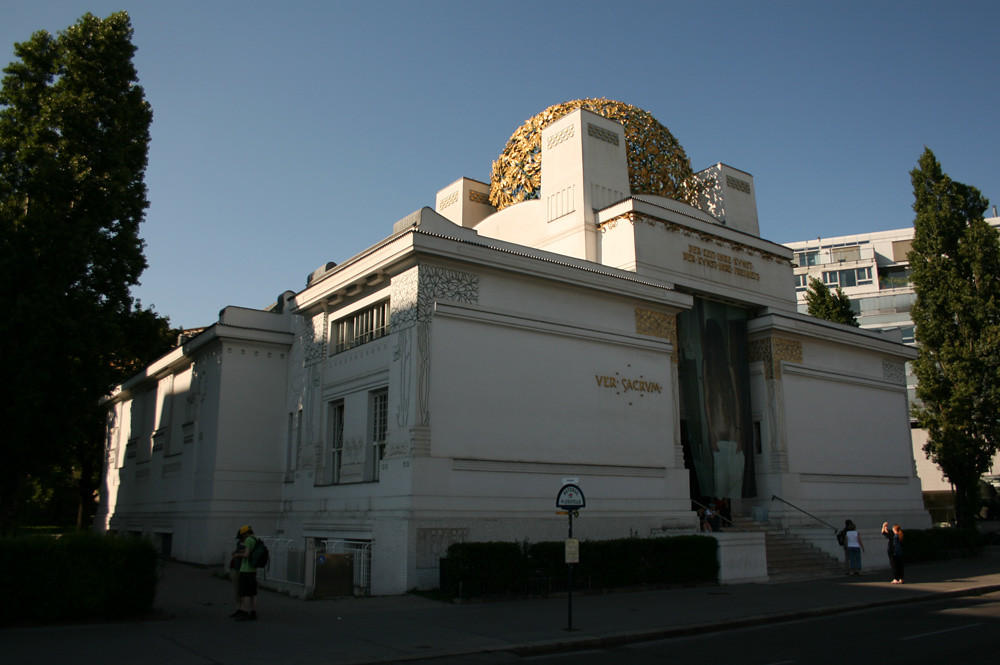
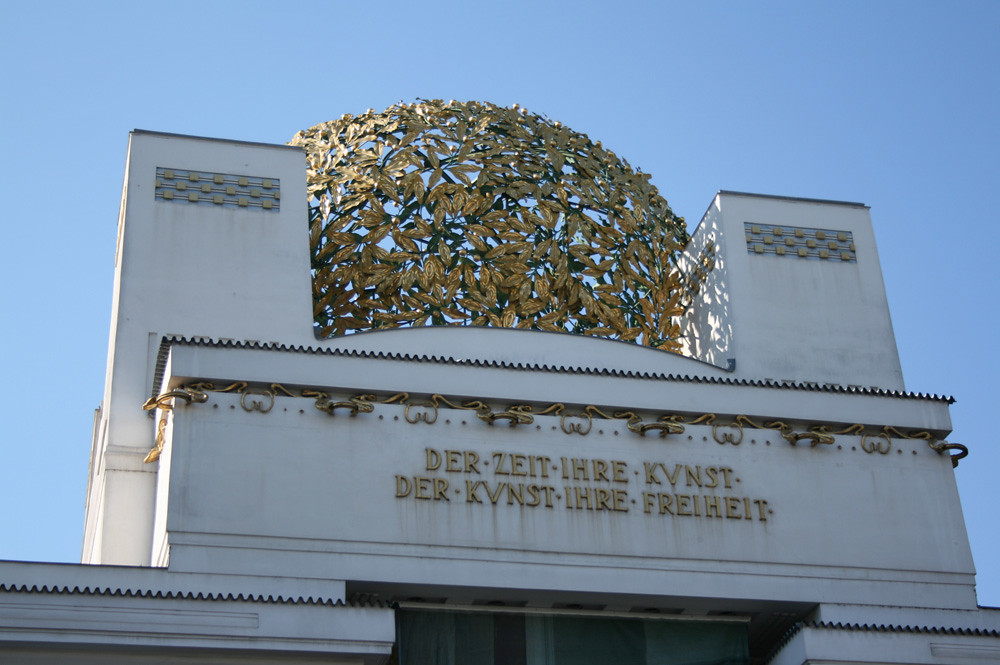
The Vienna Secession is another movement resulting from a rebellion or separation from the traditional and historical styles of art. The point was to create a completely new style unlike anything anyone had seen or done before with no ties to historical art. In this style geometric forms, linear lines and an abstract look was preferred.
Vienna secession-
The Kiss, Gustav Klimt 1907-1908

The Secession Exhibition Hall

 http://farm5.static.flickr.com/4104/4986634590_e647021c4c_b.jpg






No comments:
Post a Comment